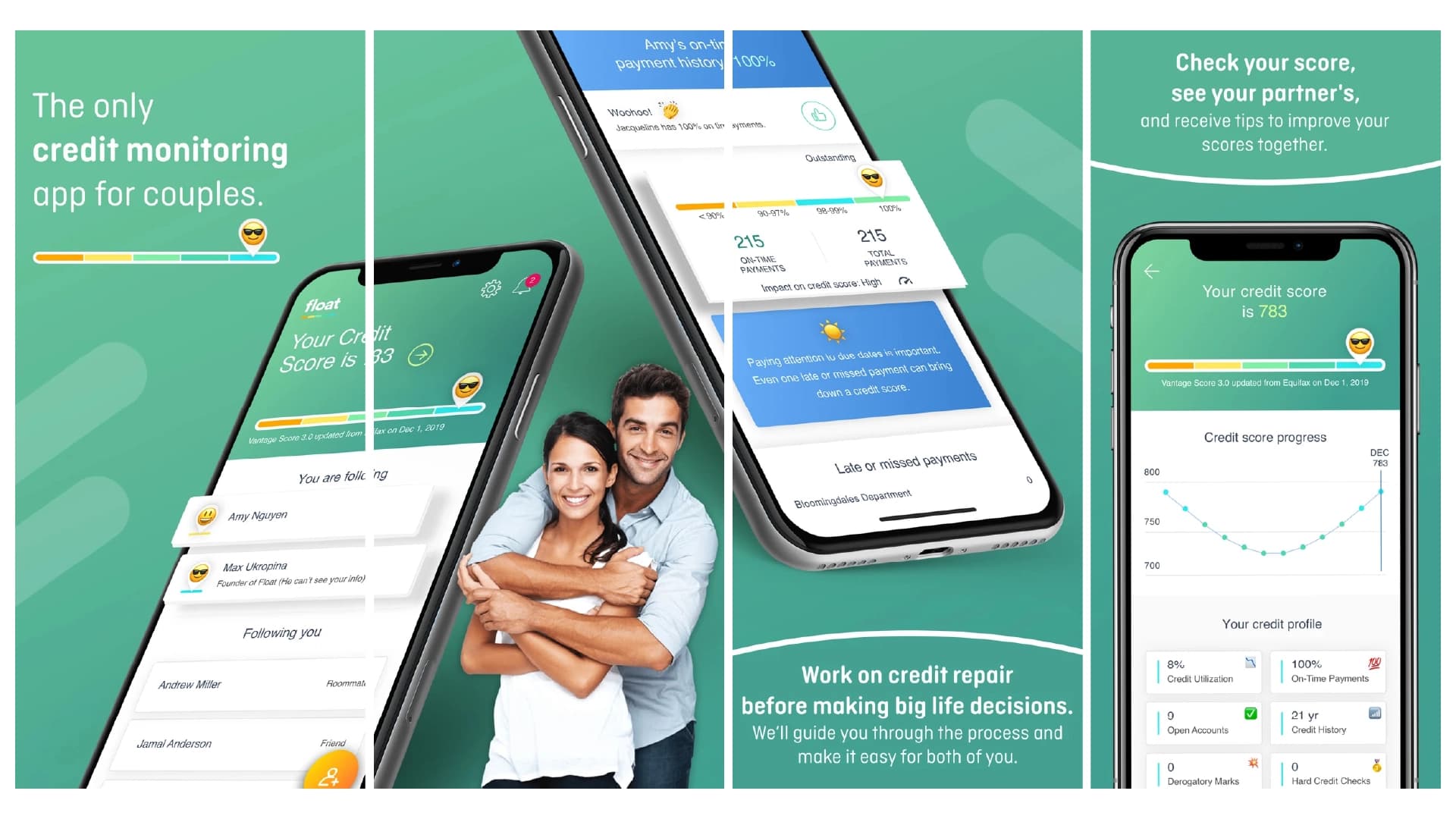
Float Credit for Couples
Secure Android engineering for a fintech app that made credit-score sharing more private, approachable, and useful — built for couples, families, and trusted connections.
Overview
Float Today was a consumer fintech startup focused on helping couples, families, and trusted connections understand credit information together. The product paired credit-score monitoring with a privacy-controlled sharing model — letting users share a lightweight emoji signal, a credit-score range, or their full score with a partner — so credit conversations could happen without all-or-nothing exposure of financial data.
Through GoatBytes.IO, I helped build the Android application — credit-score insights, controlled sharing, financial tips, and a loan and credit-card marketplace — on a Kotlin / MVVM stack with credit-data API integration, Google Tink for sensitive-data handling, and Lottie for onboarding polish. The page is preserved as a historical case study; the original product appears to no longer be publicly available.
Why credit conversations are hard
Credit decisions sit underneath some of the most consequential moments in adult life — buying a home, financing a car, combining finances, paying down debt — but the data behind them is private, confusing, and emotionally charged. Many couples avoid the conversation entirely until a lender forces it.
Float approached that gap as a product question rather than a knowledge question. Instead of pushing users toward all-or-nothing disclosure, the app made sharing a graduated choice — a lightweight signal, a range, or a full score — and built tips, monitoring, and a marketplace around the resulting conversation.
- 90%of U.S. lenders use FICO scores in lending decisionsFICO
- 3major nationwide consumer reporting agenciesCFPB
- 1 in 3couples report finances as a top relationship stressorAPA Stress in America
- ~26%of U.S. consumers have a thin or no credit fileCFPB, Data Point: Credit Invisibles
What sets it apart
Three sharing levels, not all-or-nothing
Credit information is sensitive and emotionally charged. Float gave users explicit control over how much to share with a partner, parent, or trusted contact — an emoji signal, a score range, or the full score — turning a consent question into a clear product surface.
Security-conscious mobile architecture
The Android app handled consumer credit data, third-party financial APIs, and authenticated sharing. Google Tink and AndroidKeyStore-backed primitives kept sensitive data protected at rest, and the network layer was structured around credential-aware Retrofit/RxJava flows.
From concept to launch-ready Android app
Float was an early-stage fintech startup with a tight timeline and an evolving product. The Android implementation used MVVM and Android Architecture Components for layered separation, with Lottie-driven onboarding and feature work spanning credit insights, tips, and a credit-card / loan marketplace.
My role
As Android Developer through GoatBytes.IO, I helped build Float Today’s Android application — a fintech product where consumer credit data, privacy controls, and sensitive sharing all had to feel approachable. The work covered credit-data API integration, MVVM architecture, secure local data handling with Google Tink, motion and onboarding with Lottie, and feature delivery for credit insights, tips, and the marketplace surfaces.
- Built Android features for Float Today’s consumer fintech application — credit monitoring, sharing controls, tips, and marketplace
- Integrated credit-score and financial-data workflows through third-party credit-data APIs
- Implemented MVVM architecture with Android Architecture Components for testable, layered separation
- Wired Retrofit and RxJava for authenticated credit-data flows
- Used Google Tink and AndroidKeyStore primitives for secure local handling of sensitive financial data
- Implemented privacy-controlled sharing UX — emoji, score range, and full-score levels
- Brought Lottie-driven onboarding and motion into the product experience
- Collaborated within a startup delivery model with product, design, backend, analytics, and executive stakeholders
Capabilities
- Credit-score monitoring
- Privacy-controlled sharing
- Trusted-contact connections
- Credit tips & education
- Score-change insights
- Loan & credit-card marketplace
- Couples & family workflows
- Financial wellness content
- Score history
- Onboarding & motion
- Score-update notifications
- Acquisition & funnel analytics
Distributed across
Built on
- Languages
- Kotlin
- Architecture
- MVVMAndroid Architecture ComponentsLayered domain/data/presentation
- Networking
- RetrofitRxJavaOkHttp
- Security
- Google TinkAndroidKeyStoreCertificate-aware networking
- UI & motion
- Android JetpackMaterialLottie
- Domain
- Credit-score data integrationPrivacy-controlled sharingCredit tips & educationLoan & credit-card marketplace
- Platforms
- Android
Further reading
Public sources framing Float Today’s product positioning, the engineering engagement, and the consumer-credit context the app sat inside.
- Float — Mobile App Case StudyUptech StudioProduct-side write-up of Float, including VantageScore tracking, three-level sharing, and analytics tooling for the startup.
- Building the Future of Fintech with FloatGoatBytes.IO case studyConsultancy-side write-up of the Float engagement, covering Tink, AndroidKeyStore, and the analytics strategy.
- Safeguards RuleU.S. Federal Trade CommissionFederal framework for safeguarding customer information at financial institutions — the regulatory backdrop for consumer-credit mobile products.
- Data Point: Credit InvisiblesConsumer Financial Protection Bureau, 2015CFPB research on the U.S. population without scoreable credit files — context for why approachable credit-monitoring products matter.
- Tink — Cryptographic libraryGoogleMulti-language, cross-platform cryptographic library used in Float’s Android app for secure handling of sensitive data.
“Make uncomfortable credit conversations comfortable — privacy-controlled mobile sharing for couples, families, and trusted contacts.”
Android Developer · GoatBytes.IO · Float Today
Jun 2019 – Feb 2020
This case study covers the Float Today Android engagement, delivered through GoatBytes.IO. The original product appears to no longer be publicly available; the page is preserved as a historical case study. The full role detail — other clients, scope, and consulting context — lives on the experience page.
Read the role detail